
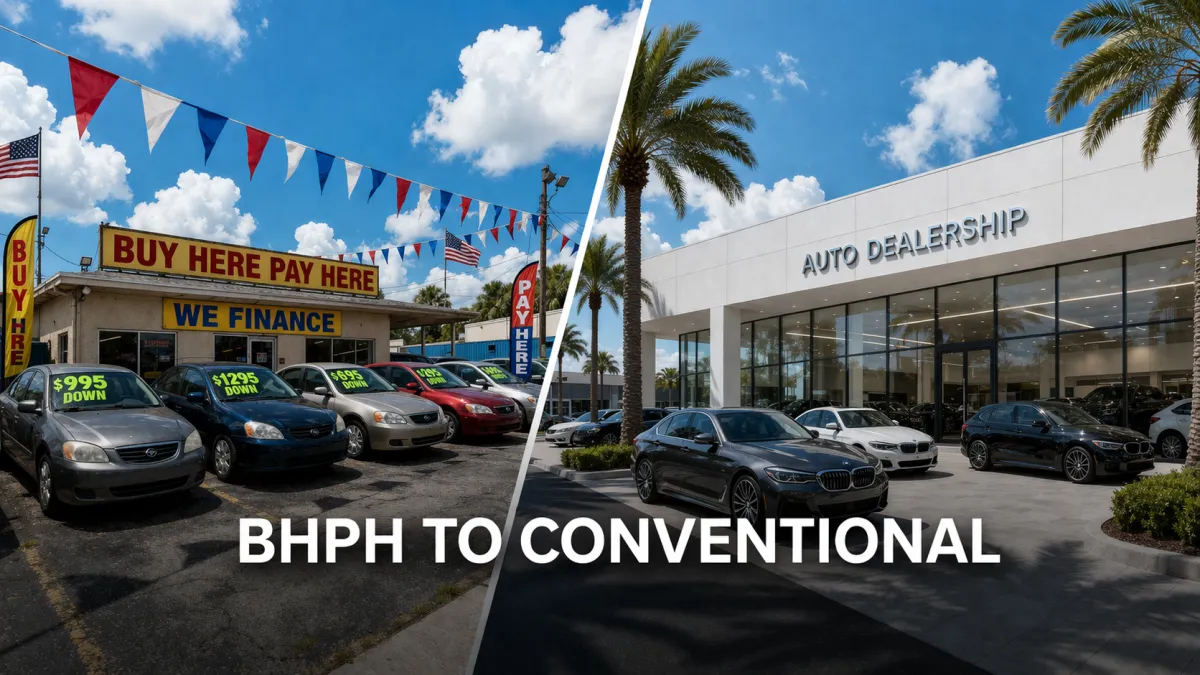
Buy here pay here dealerships are a fixture of the Florida auto market. Drive down any major road in Miami, Tampa, Orlando, or Jacksonville and you will see them: "No credit? No problem!" signs lining the lot. For thousands of Floridians with damaged or thin credit files, BHPH lots feel like the only option when they need a car to get to work.
But what starts as a short term solution often becomes a long term trap. High interest rates, limited vehicle selection, and the fact that most BHPH dealers do not report payments to the credit bureaus mean you can pay faithfully for years without ever improving your credit score. You stay stuck in the same cycle, unable to qualify for conventional financing.
There is a way out. This guide explains exactly how BHPH works, why it keeps people trapped, and the step by step plan to transition to conventional auto financing in Florida.
What Buy Here Pay Here Is and Why People Use It in Florida
Buy here pay here is a type of auto financing where the dealership itself acts as the lender. Instead of partnering with a bank or credit union to finance the purchase, the dealer finances the loan directly. The buyer makes payments to the dealership rather than a financial institution.
BHPH dealerships exist primarily to serve buyers who cannot qualify for traditional auto loans. In Florida, common reasons people turn to BHPH include:
- Credit scores below 500, which disqualify them from most conventional lenders
- Recent bankruptcy, foreclosure, or repossession on their credit report
- No established credit history at all (thin file)
- Multiple collections or charge offs making them too risky for bank financing
- Need for immediate transportation with no time to rebuild credit first
The appeal is obvious: you walk in, you drive out. No bank approval needed. For someone who needs a car to keep their job, that immediate access is worth a lot. But the cost of that convenience is far higher than most buyers realize.
The Hidden Cost of Buy Here Pay Here in Florida
BHPH dealerships are not charities. They accept the risk of lending to people with bad credit by charging significantly more for both the vehicle and the financing. Here is what that actually looks like for a typical BHPH purchase in Florida:
- Interest rates of 18% to 29% APR. Conventional auto loans for buyers with good credit typically range from 4% to 7%. BHPH rates can be three to five times higher. On a $12,000 vehicle, the difference in interest over 48 months can exceed $6,000.
- Inflated vehicle prices. Many BHPH lots sell vehicles at well above market value. A car worth $8,000 at a conventional dealership might be priced at $12,000 to $14,000 on a BHPH lot because the dealer knows the buyer has no other options.
- High down payments. BHPH dealers typically require 20% to 40% down, often collected in cash. This money is usually non refundable even if the vehicle has mechanical issues shortly after purchase.
- No credit bureau reporting. This is the most damaging aspect. Most BHPH dealers in Florida do not report your payment history to Equifax, Experian, or TransUnion. You make every payment on time for three years and your credit score does not improve at all. You gain nothing toward qualifying for better financing in the future.
- GPS tracking and kill switches. Many BHPH vehicles in Florida are equipped with GPS trackers and remote ignition disable devices. If you miss a payment by even a few days, the dealer can locate and repossess the vehicle immediately.
The real cost of BHPH is not just the money. It is the time. Every month you spend making payments that do not get reported to the credit bureaus is a month you could have been building the credit history needed to qualify for conventional financing. The cycle continues because BHPH does nothing to move you forward.
How the BHPH Trap Keeps People Stuck
The BHPH cycle works like this in Florida:
- You need a car and cannot qualify for conventional financing, so you buy from a BHPH lot
- You make payments for two to three years at a high interest rate on an overpriced vehicle
- Your payments are not reported to the credit bureaus, so your credit score stays the same
- The vehicle reaches the end of its useful life (many BHPH vehicles are older, high mileage cars)
- You need another car but still cannot qualify for conventional financing because your credit has not improved
- You go back to another BHPH lot and the cycle repeats
Some Florida BHPH buyers go through this cycle three, four, or five times over a decade, spending tens of thousands of dollars more than they would have with conventional financing, without ever building the credit profile that would break the pattern.
The system is not designed to help you graduate to better financing. It is designed to keep you as a repeat customer. Breaking out requires a deliberate strategy focused on your credit, not just your transportation needs.
What Credit Score You Need for Conventional Auto Financing
Understanding the target makes the path clearer. Here is what conventional auto lenders in Florida typically require:
- 580 to 619: Subprime approval possible with some lenders, but interest rates will still be elevated (10% to 16% APR). Still significantly better than BHPH rates.
- 620 to 659: Near prime range. Most conventional dealerships can get you approved through their lending partners. Rates typically fall between 7% to 10% APR.
- 660 to 699: Prime territory. Good selection of lenders, competitive rates (5% to 7% APR), and access to better vehicle inventory.
- 700 and above: Best rates available, typically under 5% APR. Wide selection of lenders competing for your business.
The key insight is that you do not need perfect credit to escape BHPH. Getting from a 480 to a 620 is enough to open the door to conventional financing with dramatically better terms. That jump is achievable for most people within 90 to 180 days with a structured approach. For a detailed look at realistic timelines, see our guide on how long it takes to fix a credit score in Florida.
Step by Step Plan to Transition from BHPH to Conventional Financing
Here is the actionable plan for Florida buyers who are ready to break the BHPH cycle:
Step 1: Pull Your Full Credit Report
Go to AnnualCreditReport.com and get your reports from all three bureaus. You need to see exactly what is on your file before you can fix it. Look for collections, charge offs, late payments, and errors. Many people discover items on their report that are inaccurate or outdated.
Step 2: Dispute Errors and Inaccurate Items
Credit report errors are more common than most people think. Accounts that do not belong to you, incorrect balances, paid debts still showing as open, and outdated collections that should have aged off are all disputable. Filing disputes with the bureaus is free and can result in significant score improvements if inaccurate items are removed. Our guide on how to dispute credit report errors in Florida walks through the process in detail.
Step 3: Address Collections and Negative Items
If you have legitimate collections on your report, you have options. Pay for delete negotiations, debt validation requests, and settlement offers can all reduce the negative impact. The strategy depends on the age of the collection, the amount, and whether the original creditor or a collection agency holds the debt.
Step 4: Build Positive Credit History
While cleaning up negative items, simultaneously start building positive history. The most effective tools for this are:
- Secured credit cards. Put down a $200 to $500 deposit and use the card for small, recurring purchases. Pay it off in full every month. This builds positive payment history that gets reported to all three bureaus.
- Credit builder loans. Several online lenders and credit unions in Florida offer these. You make fixed monthly payments into a savings account, and the lender reports your on time payments. At the end of the term, you get the money back.
- Authorized user accounts. If a family member with good credit adds you as an authorized user on their credit card, that account's positive history can appear on your report and boost your score.
Step 5: Manage Utilization and Inquiries
Keep your credit card balances below 30% of your limit at all times. Lower is better. Also avoid applying for new credit until you are ready to apply for the auto loan. Each application creates a hard inquiry that can temporarily lower your score. Time your applications strategically.
Step 6: Apply for Conventional Financing When Ready
Once your score has reached the 620 range, start exploring your options. Credit unions in Florida often have the most flexible auto lending programs. Get pre approved before visiting a dealership so you know your rate and can negotiate from a position of strength.
Pro tip: When you apply for auto loans, do all your applications within a 14 day window. Credit scoring models treat multiple auto loan inquiries within this period as a single inquiry, so shopping around does not hurt your score.
How Dealers Can Partner to Help Clients Upgrade
This section is for Florida auto dealers, including BHPH operators, who want to create a path for their clients to graduate to conventional financing.
The reality is that many BHPH customers want to move up. They are tired of high rates and limited selection. Dealers who help clients make that transition earn loyalty, referrals, and repeat business on better terms.
Here is how it works:
- Identify clients who are close. A client with a 550 score and stable income is not far from conventional approval. Instead of selling them another high interest BHPH vehicle, refer them to a credit improvement program.
- Partner with a credit readiness provider. The APEX Partner Program is designed for exactly this relationship. You refer the client, we fix the credit, and they come back to your dealership ready for conventional financing. Zero cost to the dealer.
- Create a referral workflow. Add a step to your F&I process: when a customer does not qualify for conventional financing, offer the credit improvement referral as an alternative to BHPH. This positions your dealership as one that genuinely helps customers rather than just capitalizing on their situation.
- Track the results. Clients who go through credit improvement and return for conventional financing become your best customers. They are grateful, loyal, and likely to refer others in similar situations.
For dealers, this is not about losing a BHPH sale today. It is about building a sustainable business model where clients return for better purchases and send their friends.
Ready to Break the BHPH Cycle?
Whether you are a Florida driver looking to qualify for conventional auto financing or a dealer who wants to help clients upgrade, APEX Credit Group has a program for you.
Frequently Asked Questions
What credit score do I need for conventional auto financing in Florida?
Most conventional auto lenders in Florida require a minimum credit score of 620 to 660 for approval at competitive rates. Some lenders will go as low as 580, but the interest rates at that level are significantly higher. To get the best rates, typically under 6% APR, you generally need a score of 700 or above. The exact threshold varies by lender, loan amount, and the age of the vehicle.
Do buy here pay here dealers in Florida report to the credit bureaus?
Most do not. The majority of BHPH dealers in Florida handle financing in house and do not report your payment history to Equifax, Experian, or TransUnion. This means that even if you make every payment on time for years, it does not help build your credit score. Some BHPH dealers have started reporting through third party services, but this is still the exception rather than the rule. Always ask before signing whether the dealer reports to all three bureaus.
How long does it take to go from BHPH to conventional auto financing?
With a structured credit improvement plan, most people can transition from BHPH to conventional financing within 90 to 180 days. The timeline depends on what is on your credit report. If the main issues are high utilization and a thin file, it can be faster. If there are collections, charge offs, or other derogatory items that need to be addressed, it may take closer to 6 months. A professional credit review can give you a specific timeline based on your situation.