
Few things generate as much anxiety in credit management as hard inquiries. People avoid applying for credit they need, refuse to rate-shop mortgages, and make suboptimal financial decisions — all in fear of inquiries that, in most cases, have a surprisingly modest impact.
This guide gives you the straight facts about hard inquiries: what they are, how much they actually lower your score, how long they last, and how to handle them strategically when you're working toward a mortgage or business funding in Florida.
Hard Inquiries vs. Soft Inquiries: What's the Difference?
Not all credit checks are created equal. The key distinction:
Hard inquiries occur when a lender or creditor pulls your credit report to make a lending decision. They require your explicit authorization (usually buried in a credit application you sign). Hard inquiries are visible to other lenders and can affect your credit score.
Soft inquiries occur when you check your own credit, when a lender pre-qualifies you without a formal application, or when employers and landlords run background checks. Soft inquiries are NOT visible to lenders and never affect your credit score — no exceptions.
How Much Does a Hard Inquiry Actually Lower Your Score?
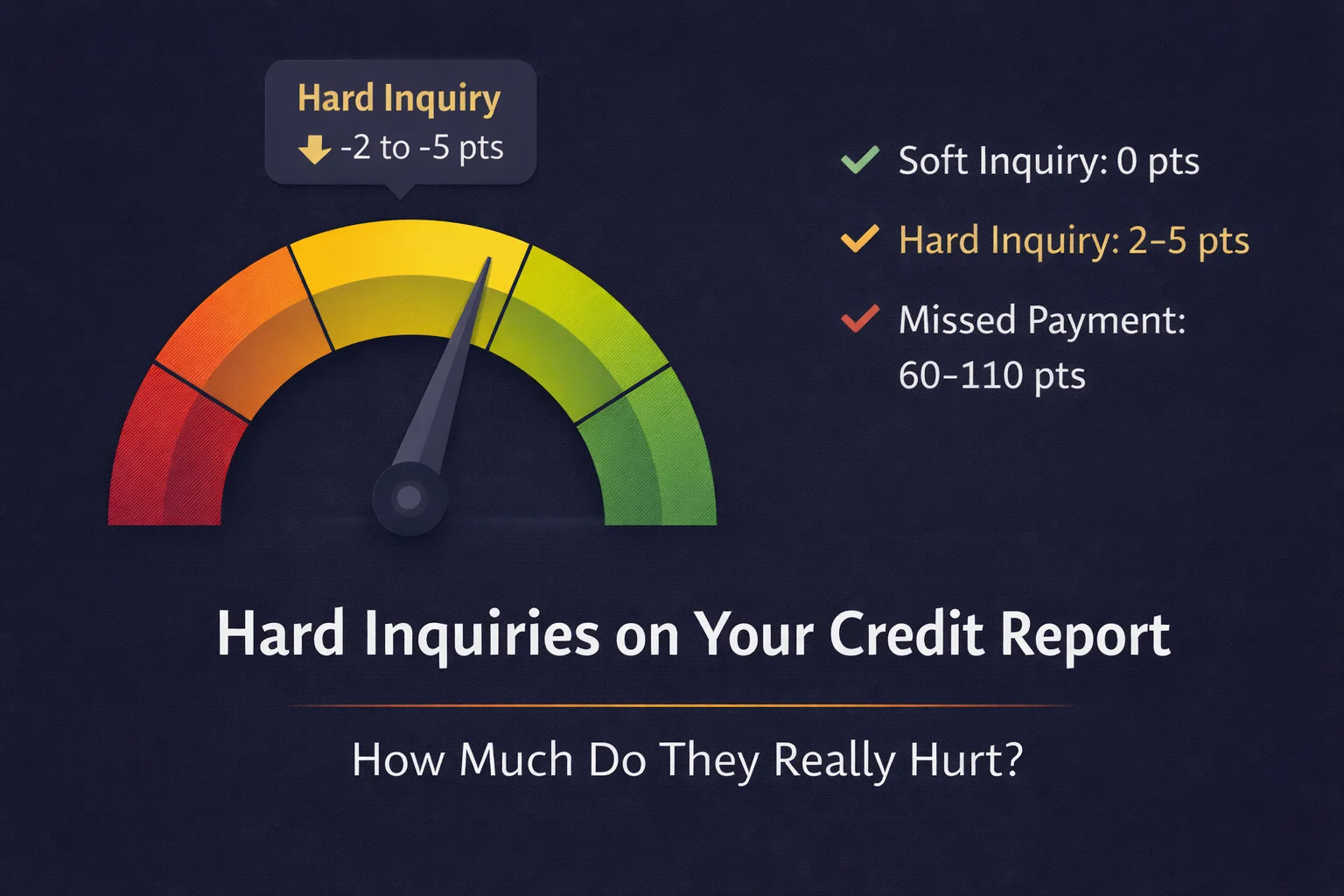
Here's where the fear often exceeds the reality. According to FICO, a single hard inquiry typically lowers your score by fewer than 5 points for most people. The exact impact depends on your overall credit profile:
- Strong credit profile (740+): Impact is minimal — often 2–3 points, barely noticeable
- Average credit (650–739): Impact is moderate — typically 3–5 points
- Thin credit file or rebuilding: Impact can be larger — 5–10 points — because there's less positive history to dilute the effect
For context: a single missed payment can drop your score by 60–110 points — and can take months to fully recover. High credit card utilization can cost you 30–50 points. In the hierarchy of credit score damage, hard inquiries are relatively minor — unless you're accumulating many of them in a short period.
How Long Do Hard Inquiries Affect Your Credit Score?
Hard inquiries stay on your credit report for 24 months (2 years). However, they typically only influence your score for approximately 12 months. After 12 months, the inquiry is still visible on your report when lenders pull it, but FICO's scoring model generally stops counting it against you.
This means if you applied for a credit card 13 months ago and were denied, that inquiry is still on your report but is no longer dragging your score down.
The Rate-Shopping Exception: Good News for Mortgage Seekers
Here's the most important rule that most Florida homebuyers don't know:
When you're shopping for a mortgage or auto loan, multiple inquiries from lenders within a 14–45 day window are typically counted as a single inquiry by FICO's rate-shopping rules. The logic: shopping for the best rate on a major loan is financially responsible behavior, and you shouldn't be penalized for comparison shopping.
Practical application: If you're mortgage shopping in Florida, get all your lender quotes within the same 30–45 day period. Five lender inquiries in 30 days counts as one inquiry for scoring purposes — not five.
The window varies by FICO model: FICO 2, 4, and 5 (used by mortgage lenders) use a 14-day window. FICO 8 and newer models use a 45-day window. When in doubt, compress your rate shopping into the shortest window practical — 14 days is the safe standard.
When Should You Be Concerned About Inquiries?
While a single inquiry is rarely a problem, there are situations where inquiries become a meaningful concern:
Multiple Inquiries in a Short Period (Non-Rate-Shopping)
Applying for several credit cards, a personal loan, and a retail card all within a few months is a different story. These don't qualify for the rate-shopping exception and accumulate as separate negative marks. Lenders see this pattern as a signal of financial stress — you may be desperately seeking credit.
Inquiries Combined with Other Negative Factors
If your credit profile already has high utilization, missed payments, and collections, even minor inquiry hits compound the damage. When you're rebuilding credit, protecting your score from unnecessary inquiries is more important than when your score is strong.
Inquiries You Didn't Authorize
If you see hard inquiries on your report from companies you've never applied to, this could indicate identity theft or a company pulling your credit without authorization. These can be disputed and removed using the same process as any credit report error.
How to Minimize Hard Inquiry Impact in Florida
Smart credit management minimizes unnecessary inquiries without avoiding credit altogether:
- Use pre-qualification (soft pull) whenever available. Many lenders and credit card companies now offer soft-pull pre-qualification before a formal application. Take advantage of this to gauge approval odds without risk.
- Batch your mortgage shopping. Don't space out lender applications over several months. Concentrate them within a 14–30 day window to benefit from the rate-shopping rule.
- Avoid opening new credit in the 6–12 months before a major loan application. If you're planning to apply for a mortgage, pause all non-essential credit applications in the months leading up to it.
- Only apply for credit you're reasonably likely to be approved for. Rejection itself doesn't affect your score, but the inquiry from the attempt does. A professional credit review tells you where you stand before you apply.
- Monitor your report for unauthorized inquiries. Set up free credit monitoring so you're alerted to any inquiries you didn't initiate.
The Bigger Picture: Inquiries Are the Least of Your Worries
Hard inquiries account for only about 10% of your FICO score. The other 90% — payment history, utilization, account age, credit mix — have far more impact. If you're working toward mortgage approval in Florida, first make sure you know what credit score you actually need to buy a house — inquiries rarely determine that outcome.
Focus on what moves the needle most:
- Pay every bill on time, every month (35% of score)
- Keep credit card utilization below 30% (30% of score)
- Don't close old accounts unnecessarily (15% of score)
If you're doing those three things consistently, hard inquiries are a minor footnote in your credit story — not the chapter that determines your outcome.
Not sure what's actually hurting your score? Our Buyer Readiness Program includes a professional credit profile review that tells you exactly what to prioritize — so you're not spending energy on minor factors while major ones go unaddressed.
Know Exactly What's Hurting Your Score
Stop guessing which factors matter most. Get a professional credit profile review and a clear, prioritized action plan — built for Florida buyers and business owners.
Frequently Asked Questions
How many points does a hard inquiry lower your credit score?
A single hard inquiry typically lowers your credit score by 2–5 points for most people. The impact is larger if you have a shorter credit history, fewer accounts, or a borderline score. The effect fades over 12 months and the inquiry disappears from your report after 2 years.
How long does a hard inquiry stay on your credit report?
Hard inquiries remain on your credit report for exactly 2 years. However, they typically only affect your score for about 12 months. After that, the inquiry is still visible to lenders but no longer factors into your score calculation.
Can you dispute and remove a hard inquiry?
You can dispute a hard inquiry if it was made without your authorization — meaning you never applied for credit with that company. You cannot remove a legitimate inquiry that you authorized when applying for credit, even if the application was ultimately denied.
Does checking your own credit score count as a hard inquiry?
No. Checking your own credit score or report is always a soft inquiry and never affects your credit score. This applies whether you check through Credit Karma, directly through a credit bureau, or through your bank's credit monitoring feature.