
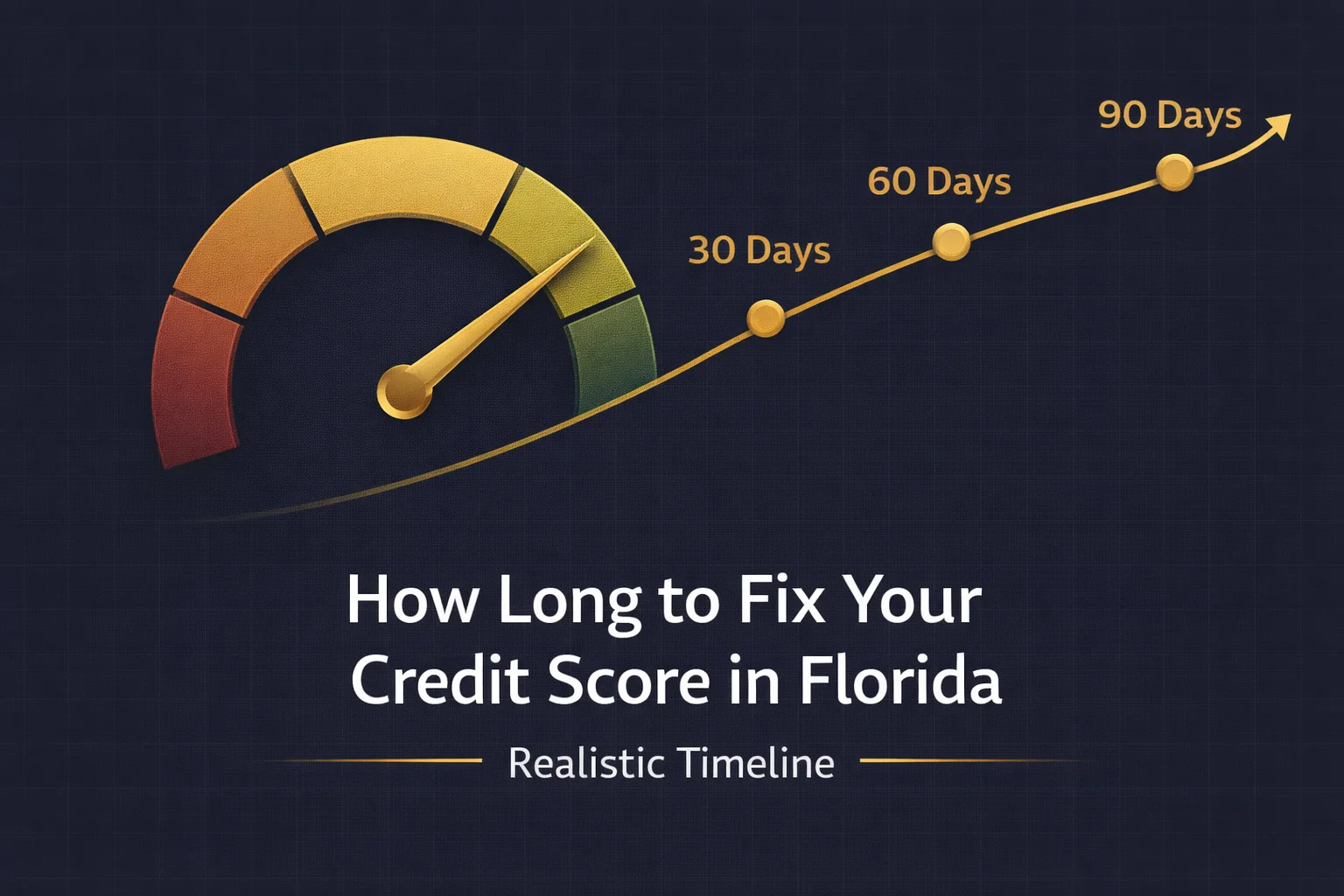
There's no shortage of websites promising you can "raise your credit score by 200 points in 30 days." The truth is more nuanced — and more useful. How long it takes to fix your credit score in Florida depends entirely on what's dragging it down in the first place.
This guide gives you a realistic, honest timeline — broken into 30, 60, and 90-day milestones — based on the most common scenarios we see with Florida buyers and business owners.
The Honest Answer: It Depends on What's Hurting Your Score
Before you can estimate how long it'll take to improve your credit score, you need to know what's causing the damage. Here are the three main categories and their typical recovery timelines:
- High credit utilization: This is the fastest fix. Paying down balances can improve your score in as little as 30–45 days, sometimes dramatically.
- Errors on your report: If inaccurate negative items are dragging your score down, the dispute process takes 30–45 days. A successful dispute can yield significant score gains quickly.
- Genuine negative history (late payments, collections, charge-offs): These take longer — 3–12 months of building positive history to offset the damage. The items themselves stay on your report for 7 years.
The biggest mistake people make: not knowing what's on their credit report before trying to fix it. You can't optimize what you haven't measured.
Factors That Determine Your Timeline
Several factors influence how quickly your credit score can realistically improve:
Your Starting Score
Paradoxically, the lower your current score, the faster you can gain points — but also the more work required. Someone at 520 can often make faster absolute gains than someone at 650, because there are more obvious problems to fix. But reaching mortgage-ready territory from 520 is a longer journey than from 650.
The Age and Severity of Negative Items
A collection from last year has significantly more impact than one from five years ago. Recently missed payments hurt more than older ones. The scoring model weighs recency heavily — which also means recent improvements count for more.
Your Current Credit Mix and History Length
If you have no active credit accounts, rebuilding your profile requires opening new accounts — which takes time to age and demonstrate responsible use. A thin file (few accounts) can be a challenge even if all items are positive.
How Consistently You Follow Through
A plan only works if it's executed. Late payments or new negative items during your improvement period can stall or reverse progress. Consistency matters more than any single action.
The 30/60/90-Day Timeline
Days 1–30
Assessment, Disputes & Quick Wins
Pull all three credit reports. Review every account for errors — incorrect balances, wrong payment status, accounts that aren't yours. File disputes with the bureaus for any inaccuracies. Pay down any credit card balances over 30% utilization. These actions alone can produce 20–50 point gains within 30–45 days if errors exist or utilization is high.
Days 31–60
Dispute Outcomes & Debt Strategy
Bureau dispute investigations conclude (federally required within 30 days). Review results. Continue paying all bills on time — every single one. If you have collections, research which ones are within the statute of limitations before paying, and consider negotiating "pay for delete" agreements. Your on-time payment streak begins to compound during this phase.
Days 61–90
Score Assessment & Pre-Application Prep
Check your score via soft inquiry (does not affect your report). Compare against your baseline. If you've reached your target, begin pre-qualification conversations with lenders using soft pulls. If not, continue your action plan — some improvements take 3–6 billing cycles to fully register in your score.
What the 30-Day Quick Wins Actually Look Like
Some improvements genuinely are fast. Here's what can produce significant score gains within a single billing cycle:
- Reducing utilization below 30% — Credit utilization accounts for about 30% of your FICO score. If your cards are maxed out, paying them down is the single fastest lever you have.
- Disputing and removing inaccurate negative items — If a collection or late payment on your report is wrong, getting it removed can produce dramatic score improvements.
- Becoming an authorized user — Being added to a family member's well-managed, long-standing credit card instantly adds that account's history to your profile. This can add 20–40 points within one reporting cycle.
What Takes 6–12 Months (or Longer)
Be realistic about what can't be rushed:
- Building payment history after a gap: If you've had years of missed payments, establishing a solid 6–12 month streak of on-time payments is required before lenders feel comfortable.
- Recent bankruptcies or foreclosures: FHA requires a 2-year waiting period after Chapter 7 bankruptcy, 3 years after a foreclosure. No amount of score improvement overrides these waiting periods.
- Aging new accounts: If you're opening new credit to build your profile, those accounts need 6–12 months of history before they meaningfully boost your score. New accounts actually briefly lower your score before they help.
- Paid collections (without "pay for delete"): A paid collection still shows as a negative mark under older scoring models. The damage reduces over time but doesn't disappear until the 7-year mark.
Florida-Specific Considerations
Florida has one of the highest rates of mortgage applications in the country, and the competitive real estate market means that lenders have options. Your credit score needs to be not just at the minimum threshold, but competitive. Here's what that means in practice:
- In Florida's competitive markets (Miami, Tampa, Orlando), sellers often review multiple offers. A buyer with a 720+ score and pre-approval is a stronger offer than one with a 620 and contingencies.
- Florida's condo mortgage market has specific restrictions — some condo buildings have financing complications that require higher credit scores to navigate.
- Florida has a high percentage of self-employed residents. Self-employed borrowers face stricter documentation requirements and generally need stronger credit profiles to compensate.
The bottom line: aim for a score of 700+ rather than just hitting the minimum threshold. See our guide on what credit score you need to buy a house in Florida to understand exactly where each lender tier sits. That extra buffer gives you better rates and positions you as a stronger buyer in a competitive market.
How to Track Your Progress
Use a soft-inquiry credit monitoring service to track your progress without adding inquiries to your report. Services like Credit Karma, Experian's free tier, or your bank's credit monitoring feature allow you to watch your score move in real time without penalty.
Set a calendar reminder every 30 days to check your score and review any changes. Document your progress — seeing the numbers move is motivating, and the record helps when you're ready to talk to a lender.
Our Buyer Readiness Program includes a structured 30–90 day action plan with regular checkpoints. You'll always know exactly where you stand and what to do next.
Get Your Personalized Credit Timeline
Stop guessing. Get a professional credit profile review that tells you exactly how long your journey will take — and what to do at each step.
Frequently Asked Questions
How fast can I raise my credit score by 100 points in Florida?
Raising your score by 100 points typically takes 3–6 months starting from the 500s or low 600s. It requires correcting errors, reducing utilization, and building positive payment history. Starting from a higher baseline, a 100-point gain takes longer because the scoring model rewards incremental improvement less at higher tiers.
Does paying off collections raise my credit score?
It depends on the scoring model. Under newer FICO and VantageScore models, paid collections carry less weight than unpaid ones. Under older models still used by many mortgage lenders, a paid collection still shows as negative. When possible, negotiate a "pay for delete" agreement — where the collector removes the account entirely in exchange for payment.
How long do negative items stay on my credit report?
Most negative items — late payments, collections, charge-offs — stay for 7 years from the date of first delinquency. Chapter 7 bankruptcy stays for 10 years. Hard inquiries stay for 2 years but meaningfully impact your score for about 12 months.
What raises a credit score the fastest?
The fastest score gains come from: (1) disputing and removing inaccurate negative items, (2) paying down credit card balances to under 10% utilization, and (3) being added as an authorized user on a well-managed account. These three actions can sometimes produce 30–60 point gains within 30–45 days.