
Most Florida business owners who apply for funding for the first time make the same discovery: their business doesn't have a credit profile. Or worse — they find out that their personal credit has been quietly funding their business activities, and the resulting utilization and inquiries have damaged their personal score in the process.
Understanding the difference between business credit and personal credit isn't just academic — it's the difference between getting approved for $150,000 in business capital or being told your file is too thin.
What Is Personal Credit?
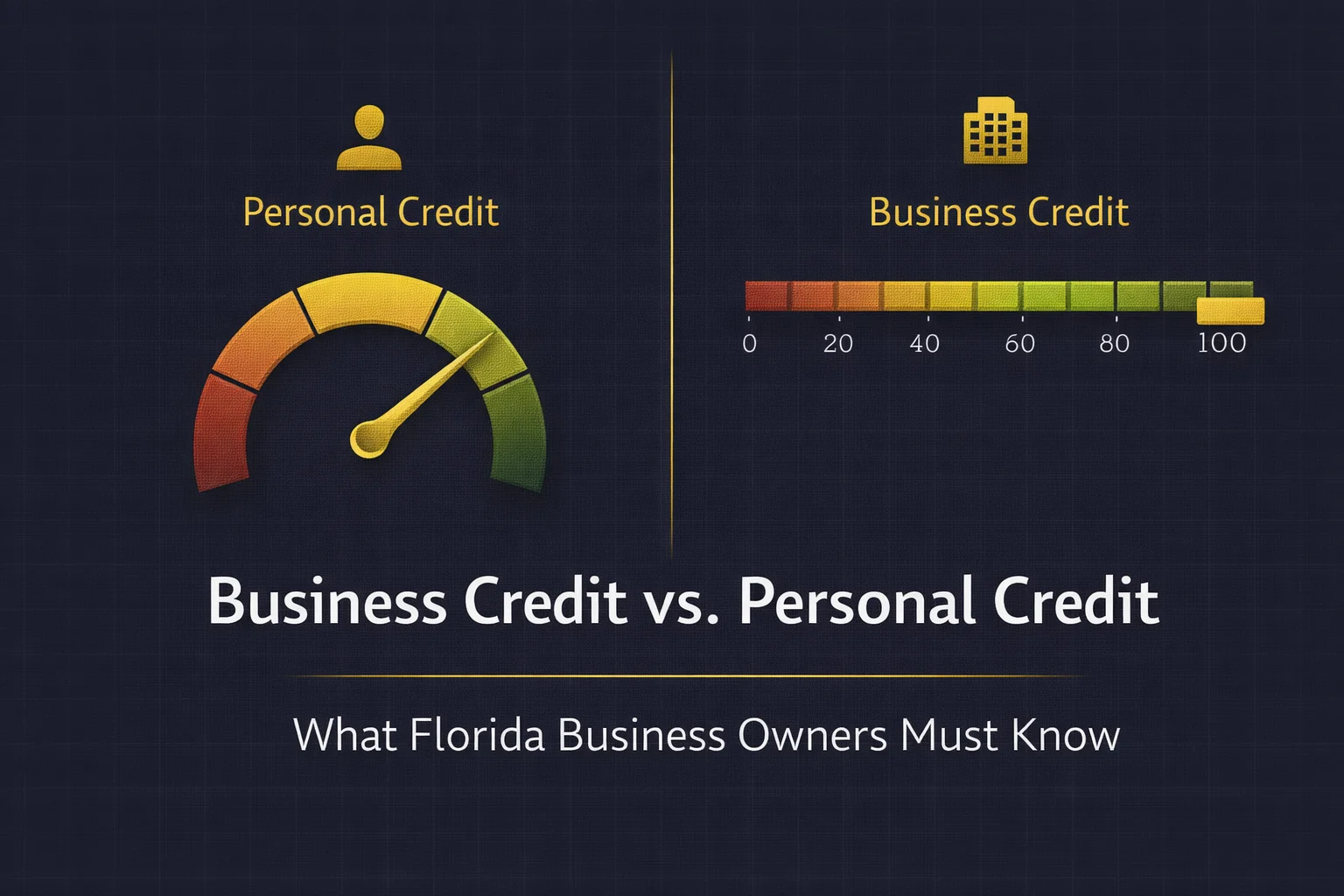
Your personal credit profile is tied to your Social Security Number (SSN) and tracks your individual borrowing history. It's maintained by the three major consumer bureaus: Equifax, Experian, and TransUnion. Your FICO score — the number most lenders use — ranges from 300 to 850 and is calculated based on:
- Payment history (35%): Whether you pay bills on time
- Credit utilization (30%): How much of your available credit you're using
- Length of credit history (15%): How long your accounts have been open
- Credit mix (10%): The variety of credit types (cards, loans, mortgages)
- New inquiries (10%): Recent applications for new credit
Personal credit follows you personally. It affects your ability to get a mortgage, auto loan, personal credit cards — and often, your business financing, because most lenders require a personal guarantee from the business owner.
What Is Business Credit?
Business credit is tied to your Employer Identification Number (EIN) — your business's "Social Security Number" — and tracks your company's borrowing and payment history separately from your personal finances.
The three main business credit bureaus are:
- Dun & Bradstreet — Uses the PAYDEX score (0–100). The most widely used in B2B lending.
- Experian Business — Intelliscore Plus (0–100). Used by many commercial lenders.
- Equifax Business — Business Credit Risk Score. Used alongside bank data and industry information.
Unlike personal credit, business credit reports are not free to access. There's also no legal mandate requiring businesses to be included — vendors and creditors report to business bureaus voluntarily. This means you have to actively build your business credit; it doesn't accumulate automatically.
Key Differences: Side by Side
| Factor | Personal Credit | Business Credit |
|---|---|---|
| Tied to | Social Security Number (SSN) | EIN / Business entity |
| Bureaus | Equifax, Experian, TransUnion | D&B, Experian Business, Equifax Business |
| Score range | 300–850 (FICO) | 0–100 (varies by bureau) |
| Free access | Yes (AnnualCreditReport.com) | No — purchased from bureaus |
| Builds automatically | Yes (from any credit activity) | No — requires active vendor/trade line setup |
| Personal liability | Always personal | Separated if structured correctly |
Why Separating Them Matters for Florida Business Owners
Florida has a thriving small business ecosystem — particularly in Miami-Dade, Broward, Hillsborough, and Orange counties. Many of these businesses are sole proprietorships or LLCs that operate on the owner's personal credit because it's the path of least resistance when starting out.
The problem compounds over time. Here's what happens:
- You open a business credit card using your SSN — it reports to personal bureaus.
- You carry balances because cash flow is tight — utilization rises, dragging your personal score down.
- You apply for a business loan — the lender pulls your personal credit and sees a 620 with high utilization and multiple inquiries.
- You're denied, or offered terms with a 28% interest rate.
- Meanwhile, your business has no independent credit profile, so lenders have nothing to lend against.
The fix: structure your business entity correctly and build business credit alongside — not at the expense of — your personal score.
How to Start Building Business Credit in Florida
Building business credit is a deliberate, step-by-step process. Here's the foundation:
Step 1: Establish Your Business Entity
If you're operating as a sole proprietor, your business and personal finances are legally the same. Forming an LLC or Corporation in Florida creates a legal separation. This is the prerequisite for everything else.
Step 2: Get a Federal EIN
Apply for an Employer Identification Number from the IRS (free at IRS.gov). This is your business's tax ID and the foundation of your business credit identity.
Step 3: Open a Business Bank Account
A dedicated business checking account in the business name demonstrates financial separation and is required by most lenders as proof of an operating business.
Step 4: Get a D-U-N-S Number
Register your business with Dun & Bradstreet to get a D-U-N-S number (free). This is required to establish a PAYDEX score — the most widely recognized business credit score in commercial lending.
Step 5: Establish Vendor Trade Lines
Apply for vendor accounts with suppliers that report to business credit bureaus — companies like Uline, Grainger, Quill, or Staples. These "net-30" accounts let you buy on credit and pay within 30 days. On-time payments build your PAYDEX score without affecting personal credit. For the complete process, see our step-by-step guide to building business credit fast in Florida.
Step 6: Apply for a Business Credit Card (EIN-Only)
After 6 months of vendor trade line history, you may qualify for a business credit card that reports only to business bureaus — not personal ones. This keeps business spending off your personal utilization.
Our Business Funding Program includes guidance on business credit structure and helps Florida business owners build the credit profile needed to qualify for $10,000–$500,000+ in business capital.
Common Mistakes Florida Business Owners Make
- Using a personal card for all business expenses: This mixes finances, raises personal utilization, and builds no business credit history.
- Applying for too many accounts at once: Multiple hard inquiries on personal credit in a short period can drop your score by 15–30 points.
- Not verifying that vendors report to business bureaus: Not all vendors report. If they don't, those on-time payments build nothing for your business credit profile.
- Ignoring business credit until a loan application: Business credit can't be built retroactively. The time to start is before you need funding.
- Operating as a sole proprietor indefinitely: Sole proprietors have no legal separation between personal and business finances, making it impossible to build independent business credit.
What Lenders Actually Look At
When a Florida business applies for funding, most commercial lenders review a combination of factors:
- Personal credit score of the owner (typically 650–680+ minimum)
- Business credit profile (Dun & Bradstreet PAYDEX, Experian Business)
- Time in business (2+ years preferred)
- Annual revenue and monthly bank statements
- Industry risk and business structure
For newer businesses (under 2 years), personal credit carries significantly more weight. This is why maintaining a strong personal credit score is crucial even as you build your business credit separately. If your personal credit is weak, read our guide on getting a business loan with bad credit in Florida before applying.
Ready to Access Business Funding in Florida?
Get a professional review of both your personal and business credit profile — and a clear action plan to qualify for the capital your business needs.
Frequently Asked Questions
Can my business credit affect my personal credit score?
It depends on how your financing is structured. Business credit cards and loans that require a personal guarantee will often report to personal bureaus — especially in the event of default. However, dedicated business credit accounts established through your EIN typically do not appear on your personal credit report.
How do I check my business credit score in Florida?
Business credit is tracked by Dun & Bradstreet (requires a D-U-N-S number), Experian Business, and Equifax Business. Unlike personal credit, there's no free annual report for businesses. You can purchase reports directly from each bureau, or use a service like Nav.com for a combined view.
How long does it take to build business credit from scratch in Florida?
Building a meaningful business credit profile takes 6–18 months. The first 90 days focus on establishing your entity, getting an EIN, opening a business bank account, and establishing vendor accounts. After 6 months of on-time payments, you can begin applying for business credit cards and small lines of credit.
What business credit score do I need for a business loan in Florida?
On the D&B PAYDEX scale (0–100), a score of 80+ is considered good. Experian Business scores of 76–100 indicate low risk. For SBA loans, lenders also look at your personal credit (typically 680+) and business financials — not just the business credit score.