
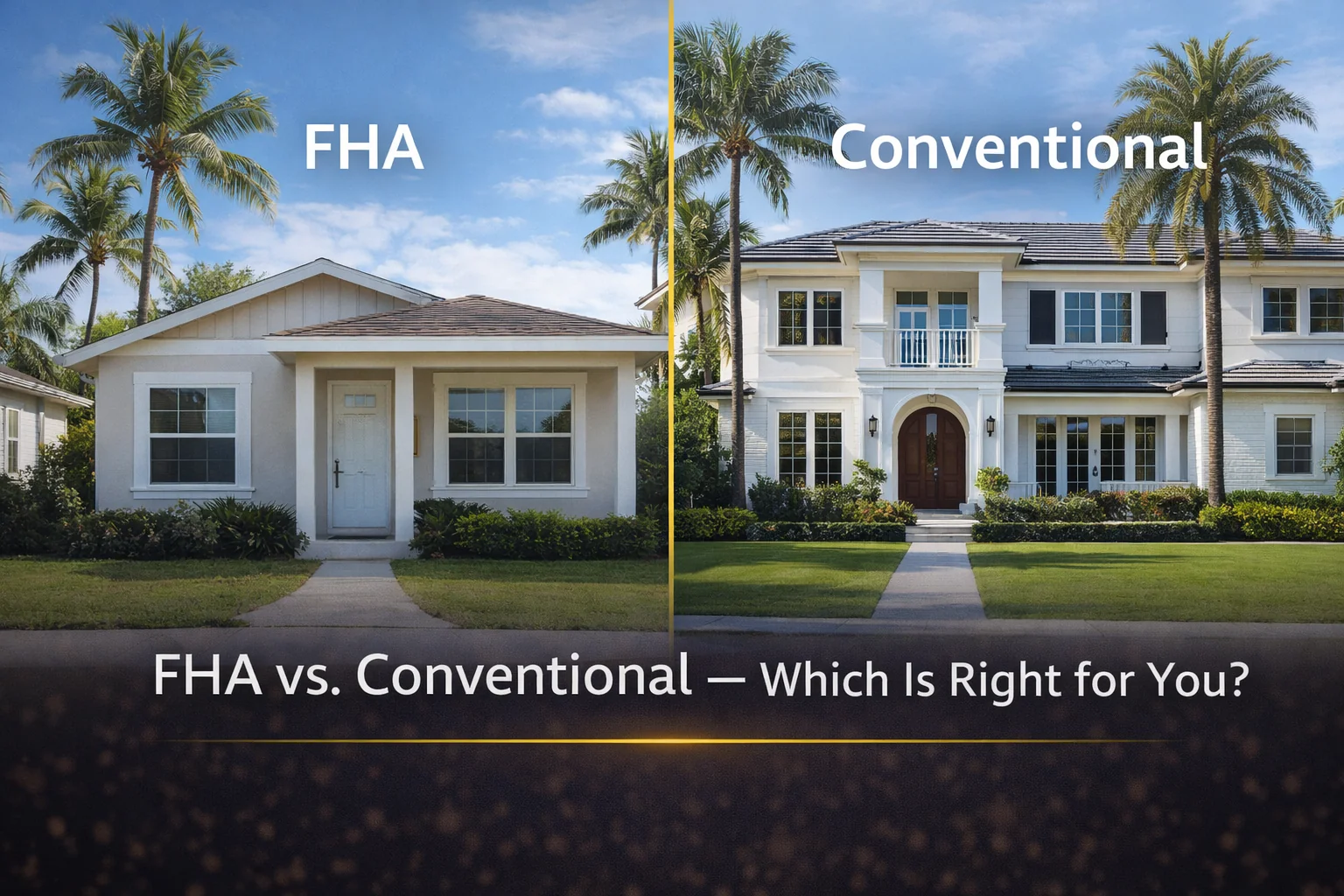
Two loan types dominate Florida's mortgage market: FHA and conventional. The choice between them can mean tens of thousands of dollars in additional costs — or it can mean the difference between getting approved and walking away empty-handed. The right answer depends entirely on your credit score, down payment, how long you plan to stay in the home, and what you're buying.
This guide breaks down every key difference, gives you the 2026 Florida loan limits, and tells you exactly which loan makes financial sense based on where you are right now.
FHA vs. Conventional: Side-by-Side Comparison
| Factor | FHA Loan | Conventional Loan |
|---|---|---|
| Minimum Credit Score | 580 (3.5% down) / 500 (10% down) | 620–640 (lender-dependent) |
| Down Payment | 3.5% (score 580+) / 10% (score 500–579) | 3–20% |
| Mortgage Insurance | MIP: 1.75% upfront + 0.55–1.05% annual | PMI: 0.2–2% annually (cancels at 20% equity) |
| Loan Limit (2026, standard) | $524,225 (single family) | $806,500 (conforming) |
| Debt-to-Income Ratio | Up to 57% with compensating factors | Up to 45–50% with strong file |
| Property Requirements | Must meet HUD minimum standards | More flexible |
| Condo Financing | Condo must be FHA-approved | More condo projects eligible |
| Insurance Duration | Life of loan (if <10% down) | Cancels automatically at 22% equity |
When FHA Makes Sense for Florida Buyers
FHA loans exist for a reason: to make homeownership accessible to buyers who don't have perfect credit or a large down payment. In Florida, where the median home price in Miami-Dade, Broward, and Palm Beach counties regularly exceeds $450,000, FHA financing opens doors that would otherwise be closed.
FHA Is Likely Your Best Option If:
- Your credit score is between 580 and 679 — FHA rates are more forgiving in this range than conventional pricing
- You have limited savings and need to minimize your down payment
- You have a recent credit event (bankruptcy discharged 2+ years ago, foreclosure 3+ years ago) that disqualifies you from conventional
- Your debt-to-income ratio is above 45% — FHA allows higher DTI with compensating factors
- You're a first-time buyer who wants the most accessible entry point into homeownership
The FHA mortgage insurance premium never goes away if you put less than 10% down — it stays for the life of the loan. On a $350,000 loan, that's an extra $160–$300 per month, every month, for 30 years.
When Conventional Is the Better Choice
Conventional loans are issued by private lenders following Fannie Mae and Freddie Mac guidelines. They don't have government backing, which means they're priced more aggressively for buyers who represent lower risk — i.e., borrowers with strong credit and meaningful equity.
Conventional Is Likely Better If:
- Your credit score is 680 or above — at this level, conventional pricing beats FHA on interest rate
- You can put 20% down, which eliminates PMI entirely from day one
- You have 10%+ down and a score above 700 — PMI will be minimal and cancels in a few years
- You're buying a condo that isn't FHA-approved
- You want to close faster — conventional appraisals are quicker and less stringent than FHA
- The home has condition issues that would fail FHA's property standards
Florida-Specific Loan Limits for 2026
Loan limits matter in Florida because home prices are high in many markets. In 2026, the standard FHA loan limit for a single-family home is $524,225 in most Florida counties (limits are set annually by HUD). High-cost areas get higher limits:
| Florida County / Area | 2026 FHA Limit (1-unit) |
|---|---|
| Most Florida counties (standard) | $524,225 |
| Monroe County (Florida Keys) | $1,209,750 |
| Miami-Dade, Broward, Palm Beach | $621,000–$726,200 (varies) |
| Collier County (Naples area) | $621,000+ |
Conventional conforming loan limits for 2026 are set at $806,500 for most areas, with high-balance limits up to $1,209,750 in designated high-cost counties (FHFA conforming loan limits). Loans above the conforming limit require jumbo financing, which has its own distinct qualification criteria.
The FHA-to-Conventional Refinance Strategy
One of the most effective strategies for Florida buyers who don't currently qualify for conventional is this: buy with FHA now, then refinance to conventional later. Here's why it works:
- You use FHA to get into the home with a lower score or smaller down payment
- You spend 2–3 years making on-time payments and building equity (Florida's market appreciation helps)
- Your credit score improves as derogatory items age and your positive payment history grows
- Once you have 20% equity and a score of 680+, you refinance to conventional — eliminating the MIP entirely
The net result: you got into the home when you otherwise couldn't, paid MIP for a few years, and then eliminated it. For many Florida buyers, this is the most practical path to long-term financial efficiency. Understanding what credit score you need to buy a house in Florida helps you plan exactly when that refinance becomes possible.
Condo Financing: A Significant Difference
Florida has one of the largest condo markets in the United States. This is where the FHA vs. conventional choice gets complicated. FHA will only finance condos in projects on HUD's approved condo list. Many Florida condo associations either have not applied for FHA approval, have let it lapse, or cannot qualify due to high investor ownership percentages or delinquent HOA dues.
Conventional loans have more flexibility — Fannie Mae and Freddie Mac each have their own condo review processes that are less restrictive. If you're buying a condo in Florida, check FHA approval status early. A condo that's not FHA-approved limits your buyer pool and your financing options significantly.
Not Sure Which Loan You'd Qualify For?
Our Buyer Readiness Program reviews your credit profile and gives you a clear picture of which loan types you qualify for today — and what it would take to qualify for better terms.
Frequently Asked Questions
Can I switch from an FHA loan to a conventional loan?
Yes. Refinancing from FHA to conventional is a popular Florida strategy. You typically need a score of 620+ (ideally 680+), 20% equity to avoid PMI, and stable income. Most buyers refinance within 2–4 years once their equity and credit score improve enough to eliminate the MIP.
Do FHA loans take longer to close in Florida?
FHA loans typically close in 30–45 days vs. 21–30 days for conventional. The FHA appraisal must be done by an approved appraiser and the property must meet HUD minimum standards. In competitive Florida markets, sellers sometimes prefer conventional offers for faster, smoother closings.
What is the FHA loan limit in Florida for 2026?
The standard FHA limit is $524,225 for a single-family home in most Florida counties. High-cost areas are higher — Monroe County reaches $1,209,750. South Florida counties like Miami-Dade and Broward have limits between $621,000 and $726,200. These are set annually by HUD.
Which loan is easier to get approved for — FHA or conventional?
FHA is generally easier: it accepts lower scores (580 vs. 620+), allows higher DTI ratios, and is more flexible with recent credit events. Conventional has stricter requirements but better long-term economics for buyers with strong credit and a 10–20% down payment.