
You have a solid income, you've found a home you want, and then the lender tells you your debt-to-income ratio is too high. It's one of the most frustrating mortgage denials — because unlike a credit score, DTI can feel like an abstract number that's hard to control.
The good news: DTI is entirely calculable and entirely improvable. This guide explains exactly how DTI is measured by Florida mortgage lenders, what the maximum limits are by loan type, and which strategies actually move the number in a meaningful timeframe.
What Is Debt-to-Income Ratio?
Debt-to-income ratio (DTI) measures how much of your gross monthly income goes toward paying debts. Lenders use it to evaluate whether you can comfortably afford a mortgage payment on top of your existing financial obligations. The CFPB defines the 43% DTI threshold as a key standard in qualified mortgage rules.
How DTI is Calculated
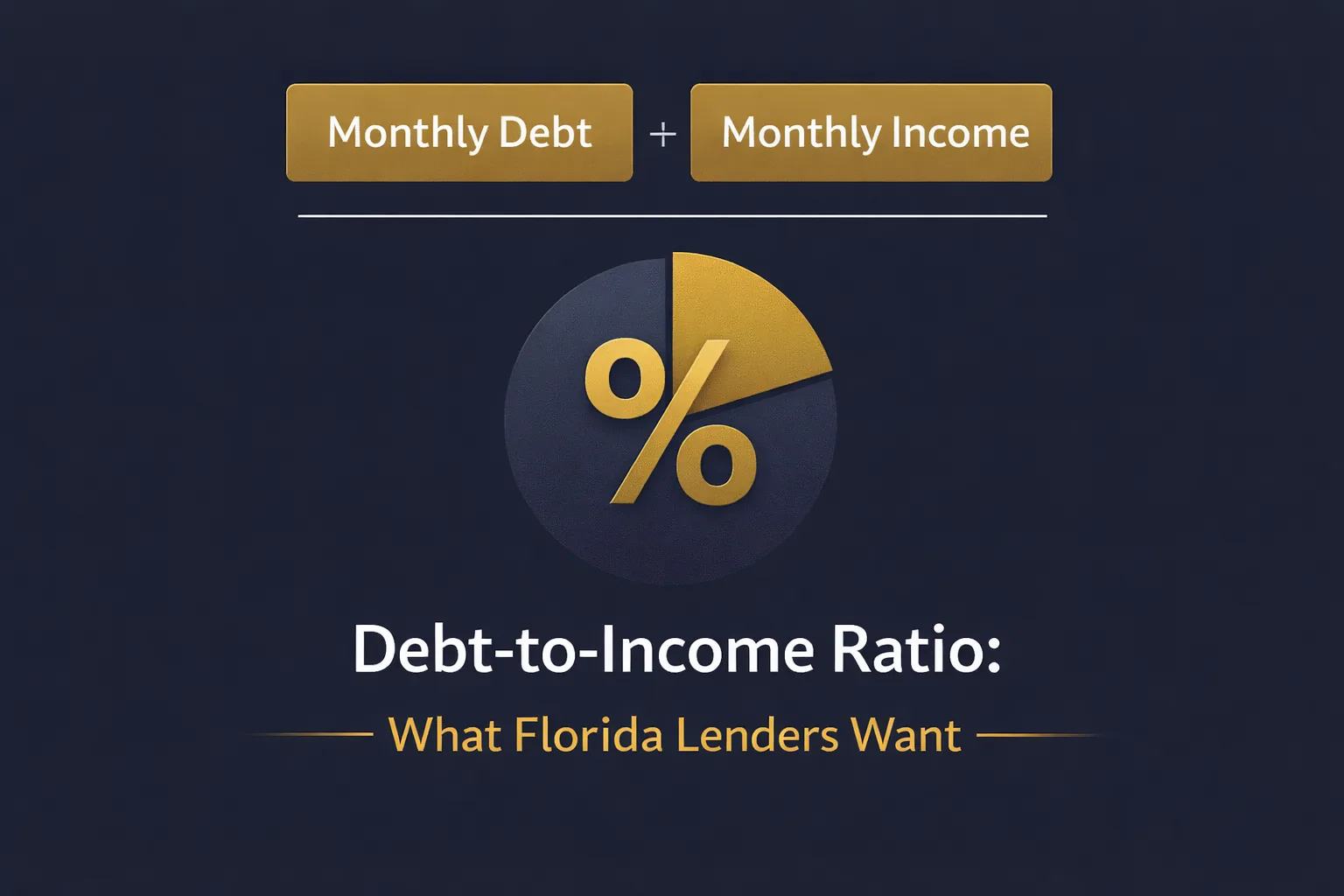
Total monthly debt payments ÷ gross monthly income = DTI
In this example: $6,000 gross monthly income, $2,400 in total monthly debt payments (including the proposed mortgage), equals a 40% back-end DTI.
There are two DTI figures lenders evaluate:
- Front-end DTI (housing ratio): Only your proposed housing costs (mortgage, taxes, insurance, HOA) divided by gross income
- Back-end DTI (total ratio): All monthly debt obligations including housing, divided by gross income
The back-end DTI is the number that typically makes or breaks a Florida mortgage application.
DTI Requirements by Loan Type in Florida
| Loan Type | Max Front-End DTI | Max Back-End DTI | Notes |
|---|---|---|---|
| Conventional (Fannie/Freddie) | 28–36% | 45% (up to 50% with strong profile) | Higher credit score and reserves may allow up to 50% |
| FHA | 31% | 43% (up to 57% with compensating factors) | Most accessible for higher DTI with compensating factors |
| VA | No hard limit | 41% preferred (no hard cap) | Residual income requirement is key; DTI cap is flexible |
| USDA | 29% | 41% | Stricter limits; rural Florida properties only |
| Jumbo | Varies | 38–43% typically | Lender-specific; stricter requirements |
Key insight: FHA loans offer the most flexibility for high-DTI borrowers in Florida. A borrower with a 680+ credit score and documented reserves may qualify with a back-end DTI up to 57% — well above the conventional limit.
What Counts as Debt in DTI Calculation
Many Florida buyers are surprised to learn what is and isn't included in the DTI calculation:
Included in DTI
- Proposed mortgage payment (principal + interest + taxes + insurance + HOA)
- Car loans (minimum payment)
- Student loans (minimum payment, or 0.5–1% of balance if deferred)
- Credit card minimum payments
- Personal loan payments
- Child support or alimony paid
- Any installment loan payments appearing on your credit report
NOT Included in DTI
- Utilities (electric, water, internet)
- Grocery and food expenses
- Health insurance premiums (unless deducted from paycheck)
- Cell phone bills
- Subscriptions and streaming services
- Insurance premiums paid separately
The Student Loan DTI Trap
Student loans are a significant DTI concern for many Florida buyers. If your loans are in deferment or on an income-based repayment plan with a $0 payment, lenders may still count 0.5% to 1% of your total balance as a monthly payment for DTI purposes. A $60,000 student loan balance could add $300–$600 to your calculated monthly debt — even if you're not making payments. This catches many buyers off guard.
How to Calculate Your DTI Before Applying
Before approaching a Florida lender, calculate your estimated DTI so you know where you stand.
Step-by-Step DTI Calculation
1. Calculate gross monthly income
Annual salary ÷ 12. For hourly workers: hourly rate × avg hours per week × 52 ÷ 12. For self-employed: 2-year average net income from tax returns ÷ 24.
2. Add up monthly debt obligations
List every item from your credit report with a monthly payment. Add child support or alimony paid.
3. Estimate your proposed housing payment
Use a mortgage calculator with the target purchase price, down payment, current interest rate, estimated property taxes, insurance, and HOA if applicable.
4. Divide total by gross income
6 Proven Strategies to Lower Your DTI for a Florida Mortgage
1. Pay Off Small Installment Loans First
A car loan with $3,000 remaining and a $350/month payment has a disproportionate impact on DTI compared to its remaining balance. Paying it off eliminates $350/month from your obligation calculation. If your gross income is $6,000/month, that single payoff reduces your DTI by nearly 6%. Identify any loans with small remaining balances and prioritize those.
2. Pay Down Credit Card Balances
Credit card minimum payments are calculated as a percentage of the outstanding balance (typically 1–2% per month). The more you owe, the higher the minimum payment — and the higher it pushes your DTI. Paying down balances reduces minimums dollar for dollar. A card with an $8,000 balance and a $200 minimum costs you 3.3% DTI if your income is $6,000. Zero that balance, and you recover 3.3% DTI.
3. Avoid Taking On New Debt Before Applying
New car, furniture financing, a store credit card — any new installment debt adds a minimum payment to your DTI calculation before the application is reviewed. The 3–6 months before applying for a Florida mortgage is not the time to open new credit lines or finance large purchases.
4. Add a Co-Borrower With Income and Low Debt
A co-borrower's income is added to the denominator of the DTI calculation, which can move the ratio significantly. If you earn $5,000/month and a co-borrower earns $3,000/month with minimal debt, the combined gross income becomes $8,000 — and the same debt payments that represented 48% DTI on your income alone now represent 30% of combined income.
5. Document All Qualifying Income Sources
Many buyers don't claim all income sources when applying for a mortgage. If you have rental income, make sure leases and tax returns document it (lenders use 75% of gross rent). Part-time work or a second job with 2+ years of history can be counted. Interest and dividend income from investments may qualify. A freelance side income with 2 years of tax returns can often be averaged in.
6. Shop Loan Types Strategically
If your back-end DTI is 47%, a conventional loan with a 45% cap may not work — but an FHA loan could still approve you, especially with compensating factors like reserves, strong credit history, or a larger down payment. Always explore FHA options before deciding you can't qualify.
DTI vs. Credit Score: Which Matters More?
Both matter — but they're evaluated differently. Your credit score affects whether you can get a loan and at what interest rate. DTI affects how much loan you qualify for.
| Factor | Credit Score | DTI |
|---|---|---|
| What it measures | Creditworthiness history | Current payment burden |
| Affects interest rate? | Yes, significantly | Minimally |
| Affects loan eligibility? | Yes (minimum thresholds) | Yes (maximum limits) |
| Fastest to improve | 60–90 days (with focused work) | 3–6 months (with debt paydown) |
| Improvable by income increase? | No | Yes — income increases lower DTI |
Compensating Factors That Help High-DTI Borrowers in Florida
If your DTI is slightly above the limit for your target loan type, lenders have discretion to approve with compensating factors. These are documented strengths in your file that offset the higher DTI risk:
- Cash reserves: 3–12 months of mortgage payments in liquid savings after closing
- High credit score: 720+ indicates strong payment history and low default risk
- Significant down payment: 20%+ shows financial discipline and reduces LTV risk
- Stable employment: 5+ years with the same employer signals income security
- Minimal payment shock: If your proposed housing payment isn't significantly higher than your current rent or mortgage
- Residual income: For VA loans, demonstrating sufficient monthly income after all obligations is key
How Long Does It Take to Lower DTI Enough to Qualify?
Most buyers with a DTI problem can resolve it within 3–6 months with a structured paydown strategy. The timeline depends on:
- How far above the limit your current DTI is
- Which debts are causing the problem (small installment loans move fastest)
- How much disposable income you can direct toward paydown
- Whether income documentation opportunities exist
The priority order: Pay off small installment loans first (highest DTI reduction per dollar). Then pay down revolving credit card debt (also reduces credit utilization, which boosts credit score simultaneously). Leave student loans last — they're the hardest to eliminate and have special DTI treatment depending on loan type.
Florida-Specific DTI Considerations
Florida has some unique factors that affect DTI calculations for mortgage applicants:
HOA fees: Florida has one of the highest rates of HOA-governed properties in the country. HOA fees are included in your front-end DTI calculation. A $400/month HOA in a South Florida condo can add 6–8% to your front-end ratio on a $5,000/month income. This surprises many buyers who focus only on the mortgage payment itself.
Insurance costs: Florida homeowners insurance is significantly higher than national averages due to hurricane risk. Lenders include the estimated annual insurance premium divided by 12 in your housing payment for DTI purposes. In coastal counties, this can be $3,000–8,000+ annually — adding $250–650 to your calculated monthly housing cost.
Property taxes: Florida's property taxes vary significantly by county. Miami-Dade, Broward, and Palm Beach counties have different millage rates that affect the tax portion of your housing payment and therefore your front-end DTI.
DTI Blocking Your Florida Mortgage?
If a high debt-to-income ratio is standing between you and pre-approval, APEX Credit Group can build a personalized paydown strategy to get you to qualification. Most clients are mortgage-ready in 3–6 months.
Start Your Readiness Plan →